- Asbestos removal
- Asbestos compensation
Can you claim asbestos compensation in South Africa?
Yes, if your asbestos disease came from mining, from living near certain old asbestos mines or (for mesothelioma) anywhere in the Northern Cape, or from your work. The Asbestos Relief Trust does not pay for exposure to an asbestos-cement roof at home.
There are four routes: the Asbestos Relief Trust for people exposed at, or near, specific former mines; The Meso Trust for mesothelioma from Northern Cape exposure; the Medical Bureau for Occupational Diseases for mineworkers; and the Compensation Fund for other workers. The Asbestos Relief Trust says claiming through it is free.
Asbestos roof, ceiling or pipes at home? Send the address on WhatsApp for an estimate, or see what removal costs.
You can claim if you have a compensable asbestos-related disease (asbestosis, asbestos-related pleural thickening, asbestos-related lung cancer or mesothelioma) and it came from one of these kinds of exposure: work at, or living near, a mine owned by or associated with one of the Asbestos Relief Trust’s founders, work on a mine, or work for any other employer. Mesothelioma from asbestos exposure in the Northern Cape has its own trust.
The Asbestos Relief Trust states that it does not compensate anyone for exposure to asbestos-cement material such as roofs, water tanks, pipes and gutters. A roof at home is something to leave undisturbed and, when it has to go, to have removed by a registered team.
Where do you claim asbestos compensation?
Where you claim depends on where you breathed in the asbestos.
| How you were exposed | Where to claim | Law or deed |
|---|---|---|
| Worked at, or lived near, a mine or mill owned by or associated with Gefco, Gencor or Msauli | Asbestos Relief Trust | Trust deed, 2003 |
| Mesothelioma from asbestos exposure in the Northern Cape | The Meso Trust (took over from the Kgalagadi Relief Trust) | Trust deed (trust no. IT 162/2024) |
| Worked on a mine (current or former mineworker) | Medical Bureau for Occupational Diseases, paid by the Compensation Commissioner for Occupational Diseases | Occupational Diseases in Mines and Works Act 78 of 1973 |
| Worked for most other employers, such as a factory or a building site | Compensation Fund (Compensation Commissioner) | Compensation for Occupational Injuries and Diseases Act 130 of 1993 |
| Lived or worked under an asbestos-cement roof, or near asbestos pipes, tanks or gutters | Not covered by the Asbestos Relief Trust; ODMWA and COIDA cover work exposure only | Asbestos Relief Trust claims FAQ |
The routes are separate and run on different rules. The Asbestos Relief Trust says that where a claimant also worked at mines that were not its founders’, an asbestosis award is apportioned by total exposure, and that anyone already compensated by Cape PLC through the British court case cannot claim from the Trust as well.
Who can claim from the Asbestos Relief Trust?
People with a compensable asbestos disease from a “qualifying operation”, and the dependants of some who have died.
Exposure: a qualifying operation
A qualifying operation is a mine, mill or other operation owned by or associated with the Trust’s founders: the Griqualand Exploration and Finance Company (Gefco), Gencor and Msauli Asbes. You qualify on exposure if you worked there, or if you lived close enough to be exposed in your living environment. The Trust has processed claims from around former asbestos mines in the Northern Cape, Mpumalanga and Limpopo, and from migrant workers in Botswana, Lesotho and Eswatini (Swaziland).
Illness: one of four categories
- ARD1: asbestos-related pleural thickening and/or asbestosis, with mild to moderate lung function impairment.
- ARD2: the same, with severe lung function impairment.
- ARD3: asbestos-related lung cancer.
- ARD4: mesothelioma.
An independent panel of occupational medicine specialists reads every claimant’s medical records. If you worked at a qualifying mine, the Trust pays for the first medical examination: a clinical examination, a chest X-ray and a lung function test.
Can family members claim after a death?
Yes. A widow, minor children or other dependants can claim if the person who died was exposed at a qualifying operation, died of mesothelioma or asbestos-related lung cancer, and the claim is lodged within three years of the death. Dependants must show they relied on the deceased financially.
What to take to the first meeting
- Your identity document.
- Proof you worked at a qualifying operation, if you have it (the Trust helps find it if you do not).
- Any medical records that diagnose an asbestos-related disease.
- For a dependant’s claim: the deceased’s ID, an unabridged death certificate, proof of marriage or dependency, and medical proof of the cause of death.
Can you claim again if it gets worse?
Yes, if you go on to develop mesothelioma or asbestos-related lung cancer. If you think your condition has worsened, you can send the Trust a chest X-ray (at your own cost) for its specialist panel to look at again. If your first examination did not qualify you, you may reapply later, but the Trust does not pay for the medical costs of a re-application.
Sources: Asbestos Relief Trust, claims criteria, forms and FAQs and home page (read 26 October 2026). Enquiries go to the Trust’s head office in Johannesburg (contact page) or artinfo@asbestostrust.co.za.
What happened to the Kgalagadi Relief Trust?
Its trustees resolved to dissolve it, and its remaining assets and responsibilities passed to The Meso Trust (trust no. IT 162/2024) with effect from 28 February 2025. By February 2024 the Kgalagadi Relief Trust had made 1,582 grant payments worth R123,302,335 to 1,532 individuals, estates, surviving spouses or dependants.
The Meso Trust said it would honour the Kgalagadi Relief Trust’s grant commitments until February 2026. From then on it awards benefits only to people who developed mesothelioma from occupational or environmental exposure to asbestos in the Northern Cape, with no limit on when or where in the province the exposure happened. Its benefits are voluntary and granted at the trustees’ discretion.
Sources: Kgalagadi Relief Trust annual report to 28 February 2024; The Meso Trust.
How much has the Asbestos Relief Trust paid out?
R493 million by 28 February 2025, against R407 million paid in by its founders, with R180 million still available on that date. In the year to 28 February 2025 it paid R28.3 million to 61 claimants (58 occupational, 3 environmental), 33 of them for mesothelioma.
The Trust was set up in 2003 with a 25-year life that can be extended by five years, to 2033. Its latest actuarial valuation says it stays solvent until 2028.
Source: Asbestos Relief Trust, 2025 Chairperson’s Report. More national figures are on asbestos in South Africa: facts and figures.
How do former mineworkers claim under ODMWA?
Through the Department of Health: the Medical Bureau for Occupational Diseases (MBOD) assesses the claim and the Compensation Commissioner for Occupational Diseases (CCOD) pays it into the miner’s bank account, under the Occupational Diseases in Mines and Works Act 78 of 1973.
Every ex-mineworker is entitled to a free medical check-up every two years at a government hospital to see whether a compensable lung disease has developed. The MBOD compensates only mineworkers; it does not pay people who lived near a mine.
The MBOD and the Trust reach different answers on some cases. The MBOD may pay for tuberculosis or for silica and coal dust disease, which the Trust does not, while the Trust needs a lung function test and can pay asbestos disease earlier.
Sources: SAnews (Government Communication and Information System, 2015); Asbestos Relief Trust FAQs.
What if a former miner dies before a diagnosis?
The family can still have the cause found. ODMWA allows compensation after death: the family tells the doctor the deceased worked on the mines, and the doctor arranges with the National Institute for Occupational Health for the heart and lungs to be removed at autopsy and examined in Johannesburg. The MBOD covers the cost, and the Asbestos Relief Trust says results usually take about five months.
Source: Asbestos Relief Trust, post-mortem.
Can workers outside mining claim from the Compensation Fund?
Yes. A worker who gets an occupational disease from working conditions can claim from the Compensation Fund under the Compensation for Occupational Injuries and Diseases Act 130 of 1993 (COIDA). Covered diseases are mainly listed in Schedule 3 of the Act, which the Minister of Employment and Labour updated on 10 November 2023 (Government Notice 4054, Gazette 49655) to follow the International Labour Organisation’s 2010 list. That list includes asbestosis and cancer caused by asbestos. You can also claim for another disease if medical evidence shows your work caused it.
Your employer must report an occupational disease within 14 days of finding out about it, and the Fund will not pay a claim made more than 12 months after the disease is diagnosed. You pay nothing into the Fund; employers do.
What does the Compensation Fund pay?
- Medical expenses for up to two years from the diagnosis.
- Temporary disability: 75% of your normal wage while you cannot work at all.
- Permanent disability over 30%: a monthly pension; under 30%: a once-off lump sum.
- Death: compensation to the spouse and children under 18, or to other dependants if there are none.
Sources: GN 4054, Gazette 49655 (gov.za); ILO List of Occupational Diseases (revised 2010), items 2.1.1 and 3.1.1; Western Cape Government.
Can you claim compensation for an asbestos roof at home?
Not from the Asbestos Relief Trust, ODMWA or COIDA. The Trust says it does not compensate anyone for exposure to asbestos-cement material such as roofs, water tanks, pipes and gutters, and a roof at home is not work exposure, so COIDA and ODMWA do not apply either. The one benefit not tied to a source of exposure is The Meso Trust’s, and it is limited to mesothelioma from asbestos exposure in the Northern Cape.
The Trust calls the risk from asbestos cement in houses generally low, because the fibres are held in hard cement, but warns that no asbestos material is safe. Its advice: do not disturb it, keep it maintained and painted, never use power tools, sanding or a high-pressure hose on it, and have it removed by trained, approved contractors.
What does the law require when it comes off?
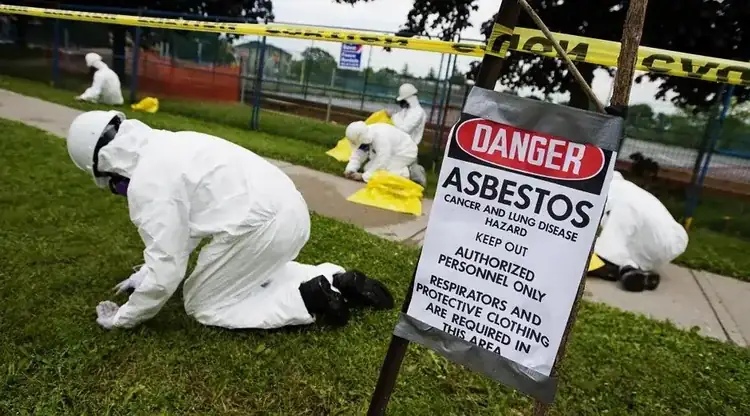
Removal is work under the Asbestos Abatement Regulations, 2020, which means a registered asbestos contractor, a plan of work, and waste that goes to a licensed landfill, followed by a clearance certificate. If you are weighing it up, see whether an asbestos roof is dangerous and how asbestos roof removal is done.
Questions people ask
Who can claim asbestos compensation in South Africa?
People with a compensable asbestos-related disease who were exposed at, or lived near, a mine owned by or associated with the Asbestos Relief Trust’s founders; current and former mineworkers, through the Medical Bureau for Occupational Diseases; other workers whose disease came from their work, through the Compensation Fund; and people with mesothelioma from asbestos exposure in the Northern Cape, through The Meso Trust.
Does it cost anything to claim from the Asbestos Relief Trust?
No. The Trust says all its services are free and urges claimants not to pay anyone to lodge a claim for them.
How long do family members have to claim after a death?
Three years from the date of death for a dependant’s claim to the Asbestos Relief Trust, and the deceased must have died of mesothelioma or asbestos-related lung cancer.
Is the Kgalagadi Relief Trust still paying claims?
No. Its trustees resolved to dissolve it, and The Meso Trust took over its assets and responsibilities from 28 February 2025. After February 2026 The Meso Trust pays benefits only for mesothelioma from asbestos exposure in the Northern Cape.
Can I claim because my house has an asbestos roof?
Not from the Asbestos Relief Trust, which does not compensate exposure to asbestos-cement roofs, water tanks, pipes or gutters, and COIDA and ODMWA cover only work exposure. Leave the roof undisturbed and have it removed by a registered asbestos contractor when it has to go.
Asbestos compensation in South Africa comes from the Asbestos Relief Trust (exposure at or near mines owned by or associated with Gefco, Gencor or Msauli; R493 million paid by 28 February 2025), The Meso Trust (Northern Cape mesothelioma; it took over from the Kgalagadi Relief Trust from 28 February 2025), the MBOD and CCOD for mineworkers under ODMWA, and the Compensation Fund for other workers under COIDA. The Asbestos Relief Trust does not compensate exposure to an asbestos-cement roof at home, and ODMWA and COIDA cover only work exposure.